

Ceramic Coating on a New Car
Decide whether to coat a new car by inspecting the paint, comparing dealer and detailer offers, and checking preparation, film and care requirements.
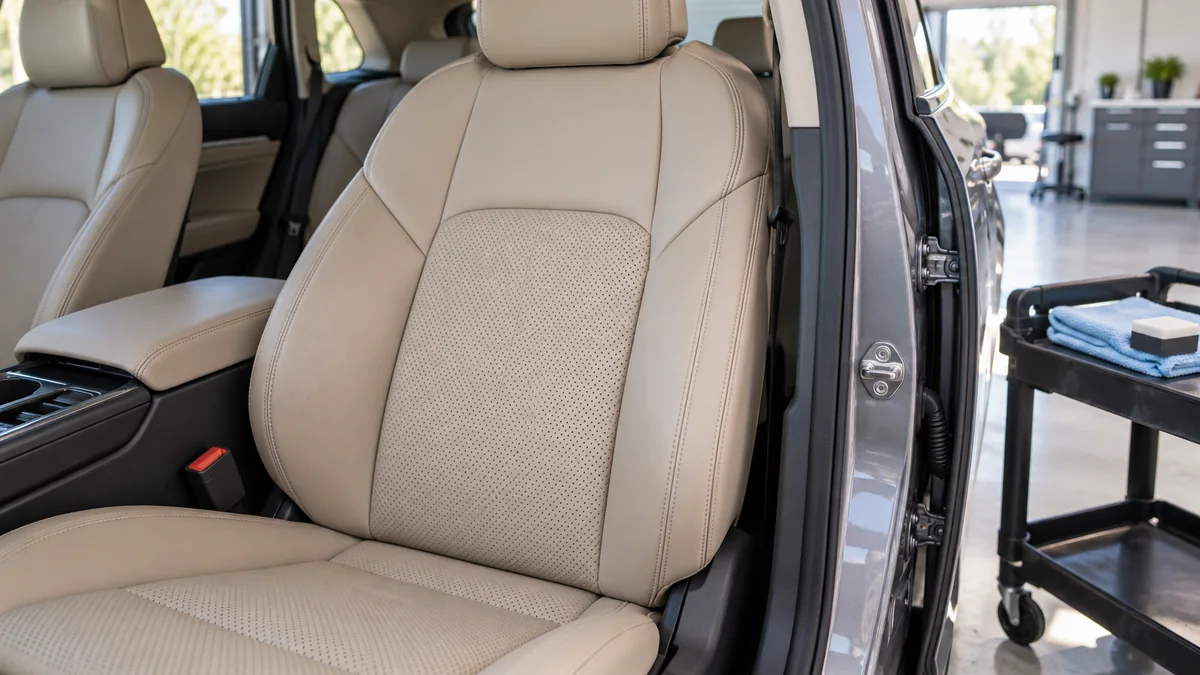
Ceramic coating for leather seats is worth considering only when the exact product suits the upholstery and your vehicle's care instructions allow it. Start with those two checks before comparing stain-resistance claims or advertised years. Some products exclude particular leather finishes, and some car manuals advise against adding seat protectants at all.
An interior package should name the seat treatment separately from the paint coating. Ask what it is meant to help with, which surfaces it covers, and what cleaning remains necessary. Do not choose a product merely because the seller calls it ceramic.
Get the upholstery specification for your model, trim and model year. A seat described in a sales listing as leather may not identify every material on its cushion, bolsters and side panels. Ask the manufacturer or installer to establish what each treated section is made from and how it is finished.
Keep these questions separate:
Do not use a water-drop experiment or aggressive cleaning to identify an unfamiliar finish. Obtain the specification and product guidance first. If the material remains uncertain, postpone the coating rather than using a visible panel as the test.
On October 15, 2026, we compared the official GYEON LeatherShield EVO product page and interior-coating manual, GYEON LeatherCoat REDEFINED page, and CARPRO US CQUARTZ Leather 2.0 100 ml page. We selected two coating examples and a leather sealant to check whether their stated material scopes were interchangeable. This is a documentation comparison of three products across four pages, not hands-on testing or a product ranking.
| Product and primary source | What the documentation specifies | What that changes for your decision |
|---|---|---|
| GYEON Q² LeatherShield EVO manual | Modern closed-structure automotive leather and high-quality artificial leather; excludes open-structure aniline/semi-aniline, vintage, worn and restored leather. | Identify the finish and repair history before treating it. The manual calls for a hidden test section. |
| GYEON Q² LeatherCoat REDEFINED | Described as a leather sealant; its FAQ identifies semi-aniline and nappa automotive leather as the primary application. | A different product in the same brand has a different stated scope. Do not transfer LeatherShield instructions to it. |
| CARPRO US CQUARTZ Leather 2.0, 100 ml | Lists traditional finished and synthetic leather, requires checking for vulnerable dyes, and labels this offering professional use only. | A synthetic-leather listing does not establish suitability for every seat. Ask the installer to confirm the material and exact supplied version. |
The useful finding is within one brand: GYEON's manual excludes semi-aniline for LeatherShield EVO, while its LeatherCoat REDEFINED FAQ names semi-aniline as a primary application. Buying the product with the more ambitious protection claim does not resolve a material mismatch.
These documents do not establish which product lasts longest, works best on your car, or prevents every stain. Read the complete instructions supplied with the exact product. Where a broad marketing statement and a specific exclusion differ, ask the manufacturer to resolve the question before application.
A coating supplier's material compatibility statement is only one part of the decision. Compare it with the vehicle manufacturer's instructions for the actual seat.
For a concrete example, the Tesla Model 3 US cleaning manual, checked on October 15, 2026, advises warm water and mild soap for ordinary spills on vegan leather and says other cleaning agents, conditioners and protectants are not recommended. Our recommendation for seats covered by that guidance is to follow the manual and skip an added coating unless Tesla provides applicable clarification.
That example does not establish the policy for every Tesla generation or another manufacturer's synthetic upholstery. Check the manual matching your car. A supplier's “synthetic leather” claim and photos of a similar vehicle do not demonstrate vehicle-maker approval.
If a dealer bundles interior protection into a new-car coating offer, request the seat product and compatibility explanation before accepting that part of the package. Keep any written clarification with the invoice.
Name the problem you want to address: dye transfer, frequent spills, difficult cleaning, or existing wear. Then ask what evidence supports the proposed treatment for that problem on your material.
GYEON describes LeatherShield EVO as reducing dye transfer and contamination while preserving the original feel. Those are manufacturer claims, not results we measured. Do not treat them as a promise that dark clothing cannot mark light seats or that cleaning becomes unnecessary.
For peeling, cracks, discoloration or an old repair, obtain a condition assessment first. Ask the shop to separate cleaning, repair and protection on the quote. If the desired result is restored color, agree on a repair outcome rather than accepting a protection description as the whole job.
For a compatible, intact seat, a hidden sample can help assess unwanted changes in color, sheen or feel. It does not prove long-term durability. Photograph the starting condition and ask when the sample should be inspected before approving the full treatment.
The product examples also differ in their waiting instructions. GYEON's LeatherShield EVO product page specifies at least six hours before using the coated surface. The cited CARPRO US 100 ml page specifies four hours without water or touching and 48 hours to full cure. These are different milestones from different instructions, not competing measures of quality.
Ask the installer for the actual collection time, when occupants may sit down, and when cleaning is allowed. Do not borrow a paint coating's curing schedule for upholstery or combine the shortest times from different products.
For perforated or ventilated seats, request instructions that explicitly address the construction before work begins. Ask how the installer controls liquid around openings, seams and adjacent components. A general leather-compatibility claim does not answer the application question.
Choose DIY only if the exact product permits it, you can identify the surface, and you can follow the whole preparation and application method. The professional-only CARPRO US offering above should not be treated as a consumer DIY recommendation. Our DIY versus professional guide helps compare the responsibilities involved.
When comparing coating shops, ask for:
Compare those details before comparing price. Our installer-selection guide explains how to check the broader package. No national leather-coating price or lifespan follows from the three product pages reviewed here.
Use it only if the exact product explicitly supports that upholstery and the vehicle guidance allows it. The leather-specific examples above already have differing exclusions; the word ceramic does not establish compatibility.
Do not combine treatments by default. Use the care method specified for your seat and chosen product. In particular, GYEON's LeatherShield EVO preparation manual excludes cleaners with softening additives, so a combined cleaner-conditioner is not an interchangeable preparation step.
This comparison did not test wear or establish a service interval. Ask the supplier how its advertised duration applies to your seat, usage and cleaning routine. Agree on inspection and maintenance instructions rather than treating a maximum duration as a guaranteed replacement date.
Decide whether to coat a new car by inspecting the paint, comparing dealer and detailer offers, and checking preparation, film and care requirements.

Choose a ceramic coating installer by checking the exact product, preparation scope, manufacturer listing, written warranty and required care costs.
Compare DIY and professional coating by product, preparation, workspace, costs and warranty. Use sourced examples to choose the work you take on.
Get the latest updates on ceramic coating technology, tips, and exclusive offers delivered to your inbox.