
Pressure Washer on Ceramic Coating?
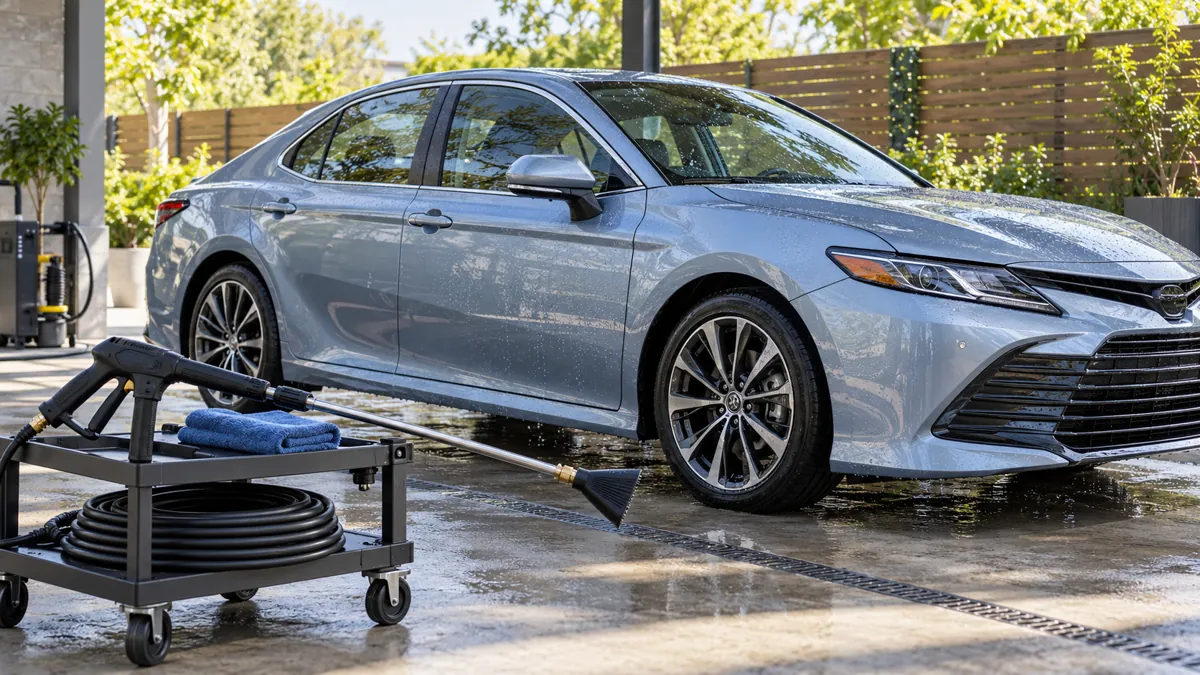
You can use a pressure washer on some ceramic-coated cars once washing is permitted, but the coating's care instructions are only part of the decision. Check the vehicle manual, any paint protection film and the washer's instructions before choosing a nozzle or working distance. There is no single PSI setting that these sources establish as safe for every coated vehicle.
Ceramic Pro's aftercare guide includes pressure-washer and foam-cannon maintenance. That permission does not override restrictions for film edges, vehicle components or a freshly applied coating. If you cannot verify those limits, use an approved gentler method or arrange a maintenance wash.
Pressure washer rules for ceramic coating
On October 21, 2026, we compared three manufacturer pages covering different parts of the same wash decision: Ceramic Pro coating care, Tesla Model Y exterior cleaning and XPEL film care. We selected them to check the scope of pressure-washing instructions, rather than to rank products. This is a document comparison, not a vehicle test or a survey of all coatings.
| Source and surface | Direction relevant to pressure washing | Decision for the owner |
|---|---|---|
| Ceramic Pro coating aftercare | Includes a high-pressure washer with a medium-grade nozzle and foam cannon. That section gives no numerical PSI limit or nozzle distance. | Ask for the actual equipment limits; do not turn a general permission into an invented pressure rating. |
| Tesla Model Y owner's manual, US edition | Specifies at least 12 inches (30 cm), continuous nozzle movement and avoiding direct jets at parking sensors where equipped. | Apply the manual for your particular vehicle. A coating does not remove component restrictions. |
| XPEL COLOR paint protection film care | Says to stay 3 feet away when using a pressure washer. | Keep this film-specific direction separate from a vehicle manual's shorter minimum. |
| XPEL TPU windshield film care | Lists at least 36 inches (1 meter), avoiding direct spray at edges, and a 40-degree nozzle. | These instructions sit under windshield film, not a universal ceramic-coating section. |
The useful finding is the difference in scope: a coating may permit a pressure washer while a surface beneath it imposes another restriction. Check all applicable instructions together. Where they conflict or leave a gap, resolve it with the installer or manufacturer before washing; do not average the distances.
XPEL's page also warns against high-pressure water near the edges of ULTIMATE PLUS and other named PPF products because it can lift or damage the film. Its separate FUSION PLUS coating section should not be used to erase those film-care limits. See our coating-over-PPF guide if your car has both.
Which nozzle and distance should you use?
Start with the instructions for your washer and the surfaces you will rinse. Kärcher's car-washing guidance specifies a flat jet rather than a rotor nozzle. That equipment guidance is useful, but it is not approval for every coating or vehicle.
Do not choose by nozzle color alone. Identify the spray pattern, angle and compatible attachment from the equipment documentation. A foam cannon and the nozzle used for the clean-water rinse are separate parts of the routine; check both.
The distances in the comparison are product or vehicle instructions, not interchangeable test results. In particular, do not copy Tesla's minimum onto XPEL COLOR film or take windshield-film nozzle advice as proof of a universal safe setup. Keep the lance moving where required and follow every surface-specific exclusion as well as the distance rule.
For an installer handover, record four items together: the approved nozzle, equipment setting, minimum distance and areas to avoid. A reply that says only “pressure washing is fine” leaves the setup unresolved.
Why a PSI number is not enough
The compared sources do not establish a common numerical PSI ceiling for ceramic coatings. We therefore cannot substantiate a blanket claim that 1,500, 2,000 or 3,000 PSI is safe for every car, nozzle and surface.
Before using equipment you already own, give the installer its model, proposed attachment and available settings. Ask for a setup compatible with the coating, vehicle and film. A pressure rating alone does not answer the distance, nozzle or edge questions in the table.
If your chosen setup leaves dirt behind, stop and reassess the cleaning method. Moving closer than permitted is not the next cleaning step. Use a compatible pre-wash or contact-wash process instead; our coated-car wash guide covers product selection and wash-media handling.
Check these areas before rinsing
Walk around the car before connecting the wash routine to a particular coating claim. Identify film boundaries, loose trim, peeling paint or other visible damage. Ask the relevant repairer or installer for a cleaning method where the surface condition is uncertain.
The Model Y manual illustrates why this matters: alongside its nozzle-distance rule, it restricts direct water at seals, electronic modules and exposed cabling, and warns against high-velocity spray toward the charge port while charging. Those are vehicle-specific directions; consult your own manual rather than borrowing this example as a complete checklist.
For film, locate the edges before rinsing and follow its care instructions. If you see lifting, do not try to clean beneath it with the jet. Send a photo to the installer and arrange assessment.
Persistent marks also need identification. Our guides to bird-dropping removal and water spots explain why cleaning products and surface compatibility matter before abrasive correction.
A first-wash checklist
- Confirm the wash date. Get the permitted first-wash date for the coating and any newly installed film. Being allowed to drive is not necessarily permission to wash. Our curing-time guide separates those milestones.
- Confirm the setup. Match the nozzle, setting, distance and excluded areas to the actual vehicle and protection package.
- Confirm the chemistry. Use approved products at their specified dilution. Do not treat a foam cannon as permission to use any detergent.
- Inspect before drying. If contamination remains, use an approved cleaning step before towel contact. Dry with suitable clean equipment rather than leaving water to evaporate.
For self-service bays, ask whether the equipment and chemicals meet those requirements and whether your intended supplies are allowed. Choose another method if you cannot establish the setup. An automatic touchless wash is a different process and needs its own compatibility check.
Common owner questions
Will a pressure washer strip the coating?
The documents compared here do not quantify coating loss or prove that every pressure wash removes a coating. They also do not guarantee every setup is harmless. Follow the named product's care rules and investigate visible damage or changed behavior with the installer.
Is a garden hose an option?
It can be, if permitted by the vehicle and coating care instructions. Kärcher also lists a garden hose with a spray nozzle as a rinsing alternative. You still need appropriate products, cleaning and drying; lower-pressure rinsing does not resolve those choices by itself.
Does a ceramic coating protect PPF edges from the jet?
Do not assume it does. XPEL's film-edge warning remains relevant when caring for that film. Ask the installer for the combined care instructions for your coating and film, and keep them with the installation records.
Stay Updated with Ceramic Coating News
Get the latest updates on ceramic coating technology, tips, and exclusive offers delivered to your inbox.