
Clay Bar on a Ceramic Coated Car
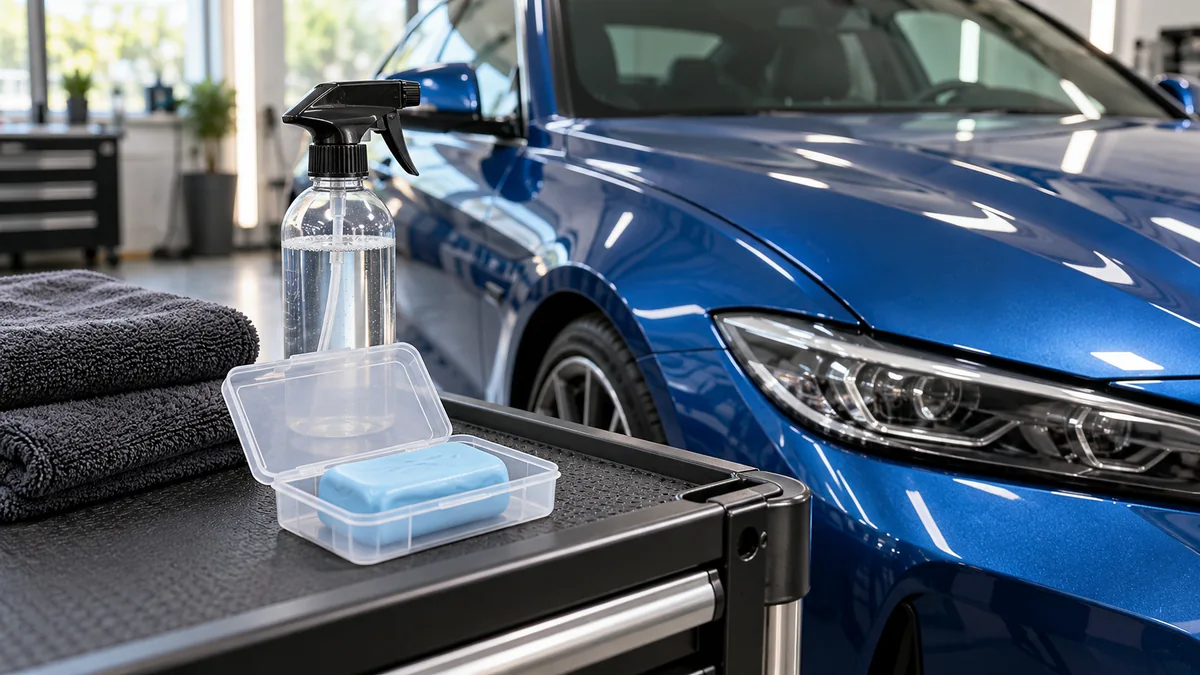
A clay bar on a ceramic coated car should be a considered treatment for remaining bonded contamination, not an automatic addition to every wash. Start with the coating's approved washing and chemical-cleaning procedure. If contamination remains, confirm that the exact clay product, lubricant and method are appropriate for your coating before proceeding.
There is no useful blanket answer that every clay treatment strips every coating, or that a fine clay bar cannot affect one. The manufacturer examples below distinguish mechanical cleaning, its potential to mark a finish, and the separate question of preserving existing protection.
What a clay bar does to the surface
Clay is a mechanical decontamination tool. It works against contamination that remains attached after washing, rather than just removing loose dirt. That contact carries a trade-off: Dr. Beasley's correction guide, pages 9–10, warns that mechanical decontamination can scratch the finish even with lubrication. It recommends chemical decontamination first to reduce the work needed from clay.
GYEON's clay guidance makes a product-specific distinction: its coarse bar may leave light marring and is recommended before paint correction. Its mild bar is marketed for maintenance and soft paints. Neither description supplies a measurement of how much of your particular installed coating would remain afterward.
That is why a smooth panel is not the only success criterion. If the treatment leaves marks that require polishing, ask what the correction would mean for the coating. Our paint-correction guide explains the preparation decision when a new coating is planned.
Five documents, three different maintenance decisions
We compared five manufacturer or official US-distributor documents on October 19, 2026. This is a purposive documentation comparison, not a hands-on test or a representative survey. We selected instructions addressing clay aggressiveness, use on coated surfaces, lubricant compatibility and chemical cleaning.
| Source reviewed | What the document supports | What to do with that information |
|---|---|---|
| GYEON global Q²M Clay Bars | Separates mild and coarse bars; warns of coarse-bar marring; says the bars resist Q²M Iron but should not be used with tar removers. | Check the grade and lubricant separately. A product called clay is not one uniform treatment. |
| GYEON USA Q²M Clay Bar EVO | Also warns of coarse-bar marring, but says both bars can be used with Q²M Iron or Q²M Tar. | The regional pages disagree about tar-remover compatibility. Confirm the instructions for the supplied product rather than combining the two recipes. |
| IGL Coatings USA Ecoclean Clay / Clay Towel | Lists ceramic-coated surfaces where mechanical decontamination is appropriate, with compatible lubricant, gentle passes and frequent rinsing. | This supports conditional use of that towel, not a ban on every clay product or approval for every coating. |
| Dr. Beasley's correction guide, pages 9–10 | Warns about scratches from mechanical decontamination and recommends chemical cleaning first. | A preparation workflow before correction is not proof that claying will preserve an existing coating. |
| GYEON Q²M RestartWash | Describes washing and decontamination for coated surfaces without adding another protective layer. | Approved cleaning can be a step before deciding whether mechanical treatment is needed. |
The practical finding is that surface compatibility, lubricant compatibility and coating preservation are separate questions. A clay supplier's statement about paint does not settle all three. The disagreement between GYEON's global and US pages is also a reason to check the current label and obtain clarification for your specific product. We could not resolve that discrepancy from these pages alone.
These are vendor instructions and claims. This comparison does not measure coating thickness, remaining lifespan, scratch frequency or warranty coverage.
Start with the problem you actually have
The car has stopped beading
Reduced beading alone does not establish that the car needs clay or a new coating. GYEON describes contamination as a cause of reduced water repellency and positions RestartWash as a cleaner for existing protection. Follow the relevant coating's care instructions and reassess after an approved wash. Our guide to a coating that stops beading separates cleaning from adding a topper.
The paint still feels rough after washing
Tell the installer where the roughness is, when it appeared and whether the car was exposed to nearby painting or construction. Ask them to identify the likely contamination and propose a compatible chemical treatment first. A rough texture is a reason to investigate; it does not identify a suitable clay grade or lubricant by itself.
If bonded contamination remains after the approved cleaning, a limited mechanical treatment may be appropriate. The IGL example shows why this is a product-and-surface decision. It is not evidence that an unknown clay mitt, towel or bar is interchangeable with the documented product.
There are rings, stains or uneven patches
Do not assume that every visible mark is something clay can lift. Our water-spot guide covers mineral-deposit assessment, while the high-spot guide covers uneven coating residue. The history of the mark matters before choosing a treatment.
Questions to ask before a clay service
Before agreeing to a decontamination package, ask for these details:
- What coating is on the car? Include the product name, any topcoat, installation date and aftercare instructions. If the coating is still curing, resolve its care restrictions first.
- What contamination remains after washing? Ask which areas need further treatment and what compatible chemical cleaning has been considered.
- Which mechanical product and lubricant will be used? Request the exact bar grade or towel and the instructions supporting the combination.
- How will the result be checked? Ask for inspection of a small initial area before committing to the whole vehicle, including a check for new marks.
- What happens if polishing is needed? Have the shop explain any coating removal, reapplication, extra cost and warranty implications before the service starts.
For a warrantied installation, ask the original installer to confirm the proposed process under your actual terms. Do not infer that every clay treatment voids a warranty, or that a warranty automatically covers corrective work. Our coating warranty guide explains which terms to request. You can also compare local detailing shops when you need an assessment.
Matte paint and film need their own instructions
This article's general decision process concerns coated gloss paint. Do not carry a gloss-paint clay-and-polish routine over to matte paint, satin finishes or film.
Dr. Beasley's Matte Decon guidance specifically warns against claying matte and satin finishes because it can alter their appearance. Read our matte-paint coating guide for that separate care decision. For coated paint protection film, check both the film maker's and coating maker's instructions; see ceramic coating over PPF.
If you have already clayed the car
Do not assume the coating is completely gone, and do not immediately polish the whole car to make the result uniform. Record the clay product, lubricant and areas treated, then inspect the clean, dry finish for new marks. Share that information with the installer if you see haze, scratches or changed water behavior.
The documentation comparison above cannot tell you how much protection survived your treatment. Get an assessment before purchasing a full replacement or adding products that make it harder to compare the treated and untreated areas.
Stay Updated with Ceramic Coating News
Get the latest updates on ceramic coating technology, tips, and exclusive offers delivered to your inbox.