
Snow Foam for Ceramic Coating
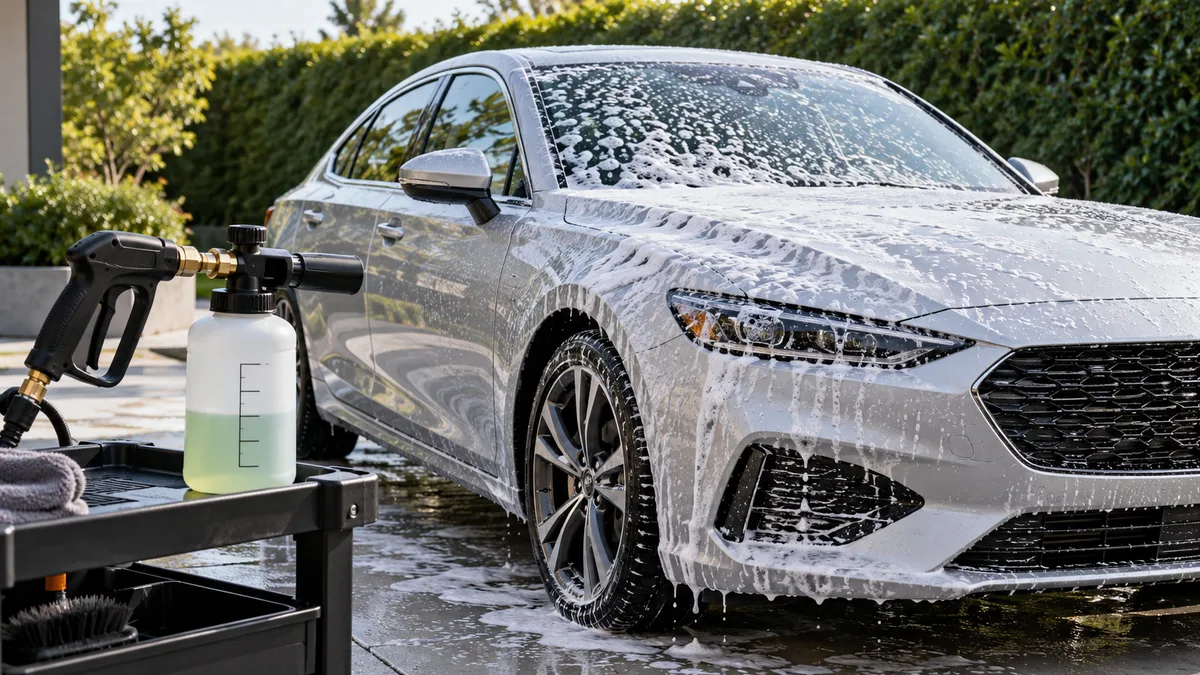
Snow foam for ceramic coating should match your coating's aftercare instructions and be mixed for the equipment you actually use. Check whether the dilution refers to the cannon bottle or the solution reaching the car. Apply under the stated conditions, rinse before drying, and do not assume a foam-and-rinse replaces the contact wash.
For a fresh installation, confirm the permitted first-wash date before using any pre-wash. Our curing-time guide explains why permission to drive and permission to wash can differ.
What the snow-foam instructions actually specify
We compared three current manufacturer pages on November 1, 2026, selecting examples with different dilution instructions. This is a document comparison, not a cleaning test, coating-durability test or ranking. The sources cover Gtechniq's US page, GYEON's global page and Bilt Hamber's UK page and linked instructions.
| Product and primary source | Published mixing direction | What to resolve before use |
|---|---|---|
| Gtechniq W4v2 Citrus Foam | Ten parts water to one part product in a foam cannon or gun | This is a bottle mix. The page identifies the product as coating-safe and specifies a cool surface out of direct sunlight. |
| GYEON Q²M Foam | Technical panel lists 1:15; application guidance says to dilute for the lance or sprayer setup | The page says it is safe for coated vehicles, but does not explain the ratio's basis as explicitly as Gtechniq. Confirm with your bottle or manufacturer rather than treating it as a panel percentage. |
| Bilt Hamber Auto-Foam | Specifies panel impact ratio, with a typical 4% example | This refers to solution reaching the vehicle. The linked instructions include an equipment-output measurement method. The cited documents do not explicitly establish compatibility with your named ceramic coating. |
The useful difference is where the dilution is measured. Copying one product's bottle recipe into another product's panel-concentration instructions can produce the wrong mixture even when both containers look equally foamy.
The Gtechniq page currently names W4v2. Check the version and regional directions on your own container; an older W4 recipe from a retailer or video is not automatically the instruction for that bottle. If the label and current manufacturer page conflict, resolve that before mixing.
Bottle dilution is different from panel concentration
A foam cannon adds pressure-washer water to the liquid drawn from its bottle. The bottle mixture and the discharged solution therefore describe different stages.
For Gtechniq's stated ten-parts-water-to-one-part-product recipe, a calculated example is 100 mL product plus 1,000 mL water: 1,100 mL total. For a 1,000 mL total fill, divide by eleven: approximately 91 mL product and 909 mL water. These are arithmetic examples, not measurements from our equipment. Stay within the bottle's capacity and use its current directions.
Bilt Hamber's downloadable instructions instead describe filling the detergent bottle with water, collecting the lance discharge until that bottle empties, then multiplying the collected volume by 0.04 for its 4% panel example. Add that amount of product to the bottle and top up with water.
For illustration only, suppose a 1 L bottle produces 10 L of collected discharge. The calculation is 10 L × 0.04 = 0.4 L, or 400 mL product, topped up with water to the 1 L bottle fill. That does not mean put 40 mL into a 1 L bottle. We have not measured this output: repeat the manufacturer's calibration for your own setup and chosen instructions. If the result exceeds the reservoir's capacity, seek equipment or manufacturer guidance rather than improvising.
Do not transfer this Auto-Foam calculation to another cleaner or interpret it as approval for a particular coating. Keep the equipment setting consistent with the calibration.
Choose for the coating and the cleaning job
Start with the coating name, any topper and its approved care products. A cleaner's general coating-safe statement is useful, but it does not replace the installation's specific aftercare rules. Ask the installer when the product or warranty requirements are unclear.
Use foam to perform the stated pre-wash job. It is not a reason to increase concentration until every stubborn mark disappears. Identify remaining deposits first: our bug-remover guide and iron-remover comparison address different contamination and compatibility questions.
Foam thickness alone is also a poor basis for choosing a mix. Bilt Hamber describes Auto-Foam as a wetting product whose bubbles break during use, rather than a product designed mainly for a persistent foam blanket. That manufacturer description does not prove it cleans better than the other examples.
Dwell, rinse and decide on the next wash step
Gtechniq specifies a three-to-five-minute dwell and says not to let the foam dry. GYEON also prohibits drying but gives no minute count on the compared page; it specifies application to a dry vehicle. Do not invent a common five-minute rule for both products. Rinse before drying even if the nominal interval has not elapsed.
Follow your vehicle and equipment instructions for rinsing. Our pressure-washer guide covers nozzle, distance and sensitive-area decisions without treating one setting as safe for every car.
Both Gtechniq and GYEON direct users onward to a contact wash. Follow the approved wash process instead of using an apparently clean foam rinse as proof that no contamination remains. Our coated-car washing guide covers shampoo choice and clean wash tools; the drying guide covers the final step.
If you need professional help choosing a care routine, use the shop directory to find an installer and ask for written instructions tied to the actual coating, cleaner and equipment.
Stay Updated with Ceramic Coating News
Get the latest updates on ceramic coating technology, tips, and exclusive offers delivered to your inbox.